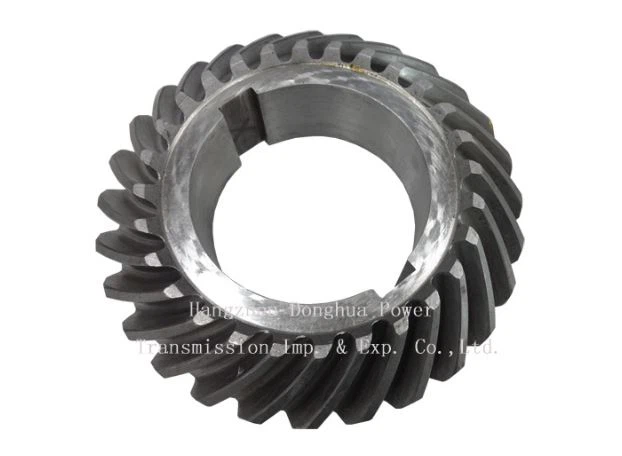
Spiral bevel gears are designed to transmit power and motion at a right angle, and they are capable of operating at high speeds. They are often used in high-performance applications, such as race cars, because they can withstand the high RPMs required for these types of vehicles. The curved teeth of spiral bevel gears allow them to transmit power smoothly and with minimal noise, making them ideal for use in precision machinery and equipment.
Spiral bevel gears are also very efficient, with transmission efficiencies ranging from 95% to 98%. This is because the curved teeth of spiral bevel gears allow for a large amount of contact area between the teeth, which reduces the amount of sliding friction and increases the efficiency of the transmission. This efficiency is especially important in applications where energy consumption is a concern, such as in hybrid and electric vehicles.
Module:0.5-16
Teeth Quantity:16-30
Pressure Angle:From 17 Degree to 25 Degree
O.D:From 26mm to 157mm
It is mainly used in vehicle differentials where the drive direction from the drive shaft must be rotated 90 degrees to drive the wheels.
What are the main things to watch out for? As mentioned above, lubricating or applying anti-seize to the bushing is the absolute wrong way to start. Next, as ever, over-torquing the screws is an easy way to damage the bushing and the shaft, reducing inefficiency until inducing failure. Finally, be sure to alternate the screws when tightening them. This process ensures a uniform pressure across the entire unit, preventing a "pinch point" or "pressure point" that will snowball into a larger problem once in operation.
All surfaces should be free of nicks and burrs, and the bushing should be free of cracks or signs of fatigue. To complete the holes, match the half-holes on the bushing with the half-holes in the hub. The holes won't line up if the threads aren't properly aligned. There will be only one thread in each hole.
Oil the threads, the point where the set screws or threads meet, and the area under the cap screws' heads. Using the threaded holes on the hub-side, lightly insert the screws.
It's best to prevent damaging the Taper-Lock bushing by using a hammer and a block or sleeve against the bush's big end with a block. If the bushing is not sitting squarely, lightly tap on it. After that, the screws are tightened even more firmly.


تگ های محبوب: , toerusting vir militêre toepassings, ratinspeksie, toerusting vir kleinhandel, toerusting vir plastiekverwerkingsmasjinerie, ligte toerusting, toerusting vir metaalbewerkingsmasjinerie